

Most homeowners hear "snaking" and "hydro jetting" used almost interchangeably, as if they're two brand names for the same service. They're not. They solve different problems, and using the wrong one either wastes money or leaves the real cause of the clog sitting in the pipe, waiting to come back.
If you already tried the basic DIY route, a plunger, a zip tool, maybe a rented hand-crank snake, and the clog either didn’t budge or came right back, the decision you face now is which professional method actually fixes the problem.
What Is Hydro Jet Plumbing, and How Is It Different From Snaking?
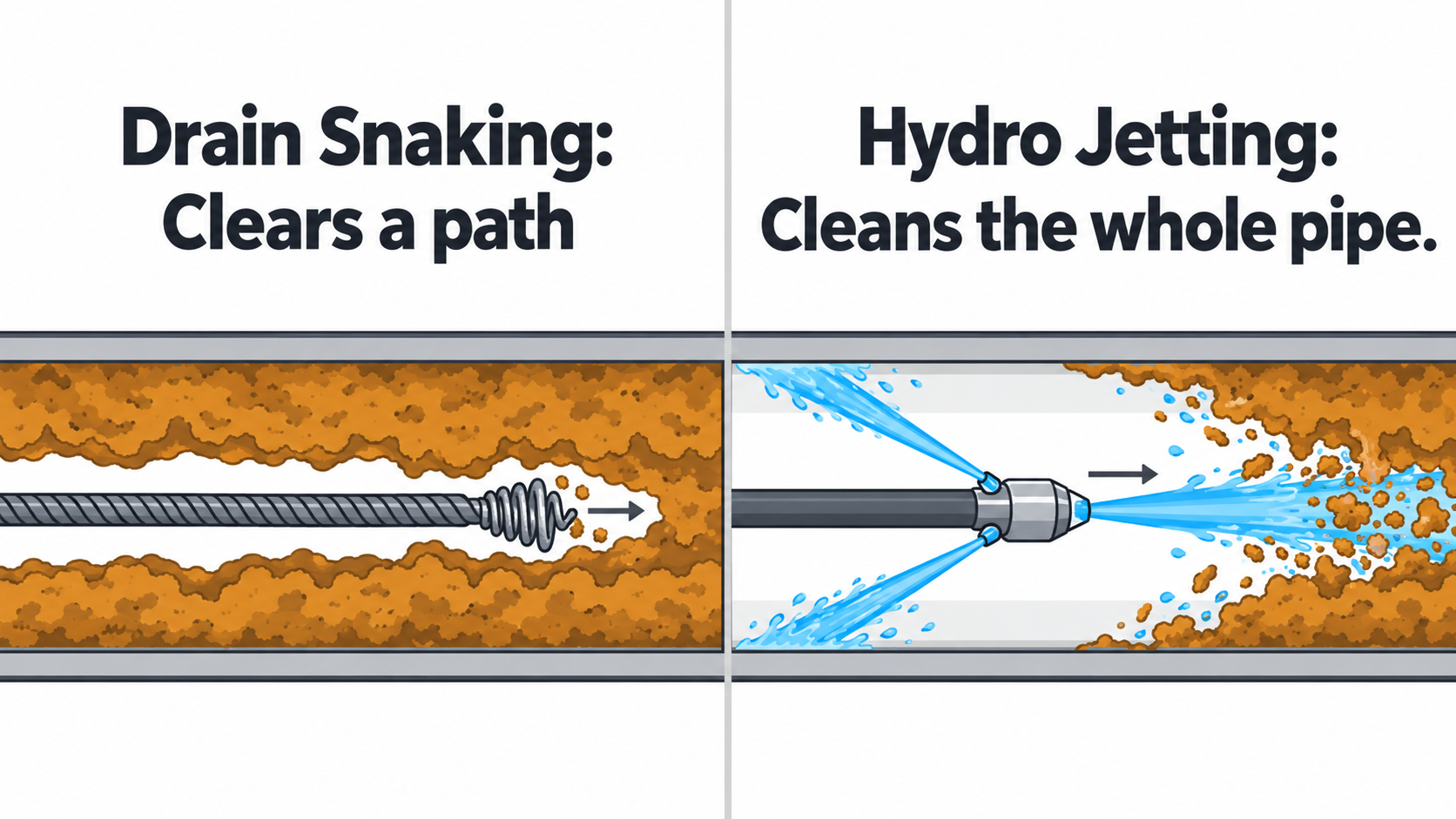
Hydro jet plumbing is a drain and sewer line cleaning method that uses pressurized water instead of a mechanical cable to clear a pipe. Drain snaking, the more familiar method, pushes a flexible cable through the line to physically break apart or hook a clog. Both get water flowing again. Only one of them actually cleans the pipe while it's at it, and that distinction is the whole reason this comparison matters.
The short version: a drain snake solves a blockage. Hydro jetting solves a blockage and the buildup that caused it. Which one your home actually needs depends on what's going on inside the line, not just what's convenient or familiar.
How Drain Snaking Works
A drain snake is a flexible metal cable fed into the pipe by hand or motor until it reaches the blockage. The cable terminates in an interchangeable head, an auger head twists into soft blockages like hair and paper, a spear or spade head punches through denser clogs, and a retrieval head is built to hook and pull back an object rather than break it apart. Professional-grade sectional cable machines can run cables 75 to 100 feet or more, far beyond what a consumer hand-crank model reaches.
For a single, isolated obstruction, a child's toy, a wad of hair, a clump of toilet paper, this is fast, affordable, and does exactly what's needed. What it doesn't do is clean the rest of the pipe. A snake opens a channel through the blockage roughly the width of the cable head, leaving whatever is coating the pipe walls on either side of that channel untouched.
How Residential Hydro Jetting Works
Hydro jetting uses a flexible, high-pressure hose fitted with a specialized nozzle that sprays water forward and backward simultaneously as it's fed through the line. The forward jets cut through blockages ahead of the nozzle, while the rear-facing jets pull the hose forward and scour the pipe wall behind it at the same time. Residential hydro jetting equipment typically runs at pressures in the range of 1,500 to 4,000 PSI, calibrated to the pipe material and condition found during inspection, high enough to strip grease, sludge, mineral scale, and root fragments off the interior wall, without being the uncontrolled blast people sometimes picture.
Hydro jetting isn't a new or experimental method. It was originally developed for municipal and industrial sewer maintenance, where crews needed a way to clear miles of pipe without tearing anything up, long before smaller, trailer- and cart-mounted units made the same technology practical for residential plumbers to bring to a single home.
Because it relies entirely on water pressure rather than chemicals, hydro jetting also clears a line without introducing anything corrosive into the pipe, which matters for the long-term condition of older plumbing in particular.
What to Expect During a Hydro Jetting Appointment
Every hydro jetting visit starts with a camera inspection, not the jetting itself. A technician runs a camera through the line first to confirm the pipe material, locate the blockage, and verify the line can safely handle pressurized water. That inspection determines the pressure setting and nozzle type used, rather than defaulting to a single setting for every home.
Once the inspection is complete, the jetting hose is fed into the line and the nozzle does its work in both directions, cutting forward through the blockage and cleaning backward as the hose is pulled out. A second camera pass follows, confirming the line is fully clear along its length, not just open enough to drain today.
When Snaking Is the Right Call
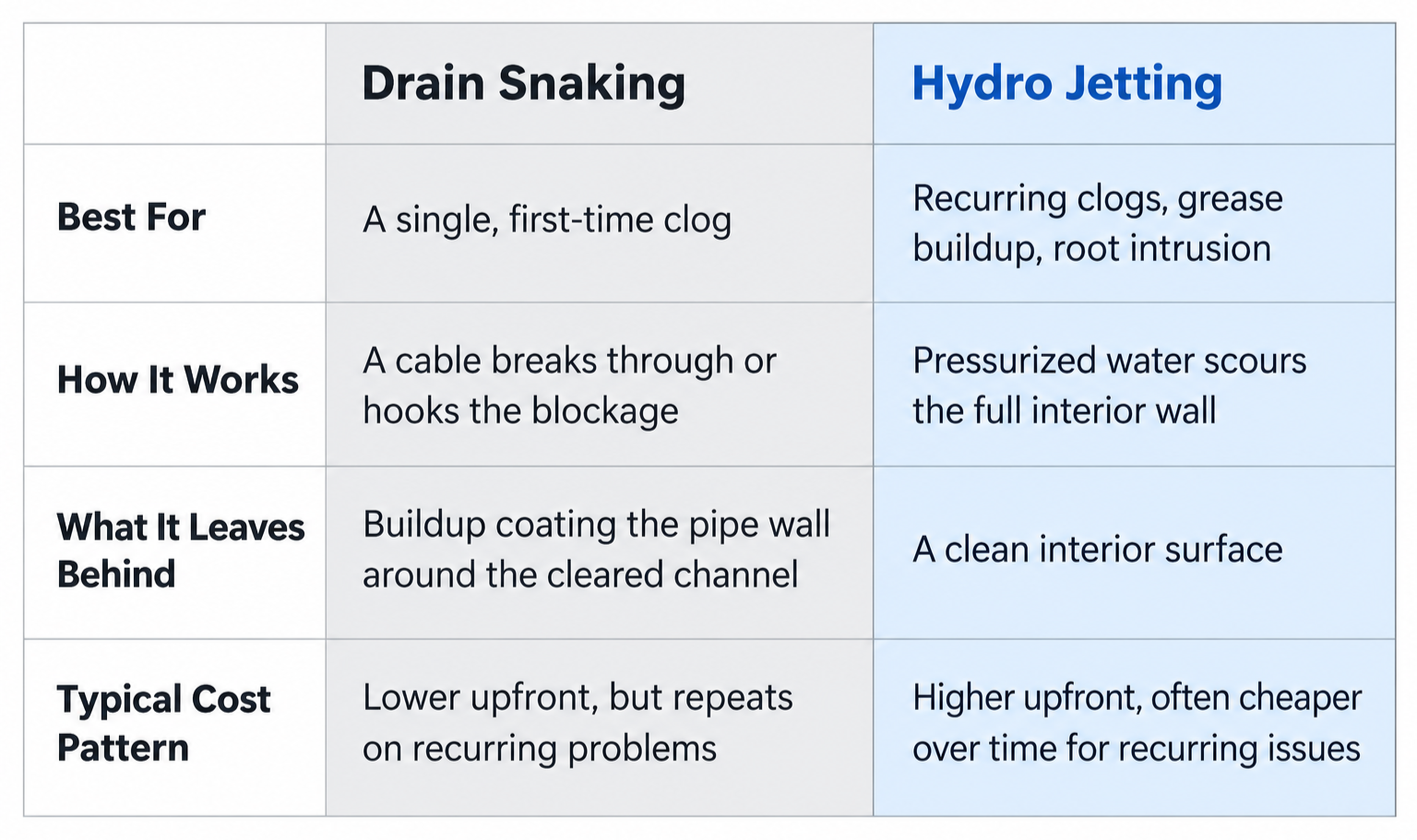
If this is the first time a drain has clogged, if it's a single fixture rather than multiple ones, and if there's no history of recurring problems in that line, snaking is usually the right first step. It costs less and solves a straightforward problem without overcomplicating it.
When Hydro Jetting Makes More Sense
Snaking covers the simple case, but plenty of situations aren’t simple. These are the signs that point toward hydro jetting instead:
The same drain has clogged more than once in the past several months
Kitchen lines dealing with heavy, ongoing grease buildup
Sewer line hydro jetting is being considered because of confirmed or suspected tree root intrusion (a real concern across East Texas given how much of our sewer line infrastructure sits in clay soil prone to shifting)
Older homes on cast iron or clay pipe where mineral scale has had decades to build up
Before buying or selling a home with an older sewer line, as a preventive step rather than a reactive one
Can Hydro Jetting Damage Older Pipes?
This is a fair question, and the honest answer is that it depends on the pipe, which is exactly why a camera inspection happens before jetting, not after. Modern PVC, properly maintained cast iron, and most clay pipe in reasonable condition handle hydro jetting without issue. The exception is pipe that's already significantly deteriorated, badly corroded cast iron, or Orangeburg pipe, a bituminous fiber material commonly installed from the 1860s through the 1970s and known for softening and collapsing with age. On a line in that condition, pressurized water can worsen an existing weak point instead of just cleaning it.
There’s a second variable worth knowing about if your home is one of many in East Texas running on a septic system rather than municipal sewer: pressure needs to be calibrated differently for a line that empties into a septic tank. Full residential pressure aimed carelessly near an aging septic baffle can do real damage, which is exactly why confirming which system a property is on, city sewer or septic, is part of how we approach drain cleaning across East Texas, especially in the smaller communities where septic is often the norm rather than the exception.
Why a Camera Inspection Always Comes First
A camera inspection shows the pipe material, its condition, and the actual cause of the blockage before any decision gets made between snaking and jetting. Skipping that step means guessing, and guessing wrong on this particular choice either wastes money on a service the line didn't need, or risks damage to a pipe that couldn't safely handle it. It's the same process whether the job is in Longview or Tyler, and it's the reason our price doesn't change once a job is already underway.
Snaking vs. Hydro Jetting: The Cost of Guessing Wrong
Snaking is the cheaper service call, which makes it tempting to default to every time. But a line with buildup along its length, not just a single obstruction, will clog again on roughly the same timeline no matter how many times it's snaked. Paying for the same service repeatedly on a recurring problem typically costs more over a year than paying once for the hydro jetting visit that actually addresses the buildup. The right first question isn't which service costs less today. It's whether this is a one-time blockage or a pattern, since that answer determines which option is actually cheaper over time.
Frequently Asked Questions
Is hydro jetting safe for old pipes?
For most older pipe in reasonable condition, yes. For pipe that's already significantly deteriorated, particularly old Orangeburg or badly corroded cast iron, jetting without a prior camera inspection carries real risk. A camera inspection happens before jetting specifically to avoid this.
Does hydro jetting cost more than snaking?
Generally, yes, upfront, because it's a more thorough process addressing buildup along the full pipe rather than clearing a single blockage. For a line with recurring problems, it's often less expensive over time than repeatedly paying to snake the same clog.
How often does a sewer line need to be hydro jetted?
Most homes don't need routine jetting on a schedule. It's typically recommended when there's a documented history of recurring clogs, confirmed grease buildup, or known root intrusion, not as blanket preventive maintenance for a line with no history of problems.
Can I rent hydro jetting equipment and do this myself?
Commercial-grade hydro jetting equipment runs at pressures that can damage a pipe in unskilled hands, and without a camera inspection first, there's no way to know if a line can safely handle it. This isn't a DIY-recommended service the way basic snaking can be for a simple clog.
What's the difference between hydro jetting and sewer line hydro jetting?
They're the same process. "Hydro jetting" usually refers to clearing any drain line, while "sewer line hydro jetting" specifically describes using the method on the main line rather than an individual fixture drain.
Is hydro jetting safe for homes on a septic system?
It can be, but the pressure and approach need to be adjusted for a line connected to a septic tank rather than municipal sewer. Confirming which system a property is on is part of the inspection before any work starts.
Call A/C Contractors at (903) 496-5947 for a camera inspection and the right fix, not just the first one, for your drain or sewer line in Longview, Tyler, or elsewhere in East Texas.


